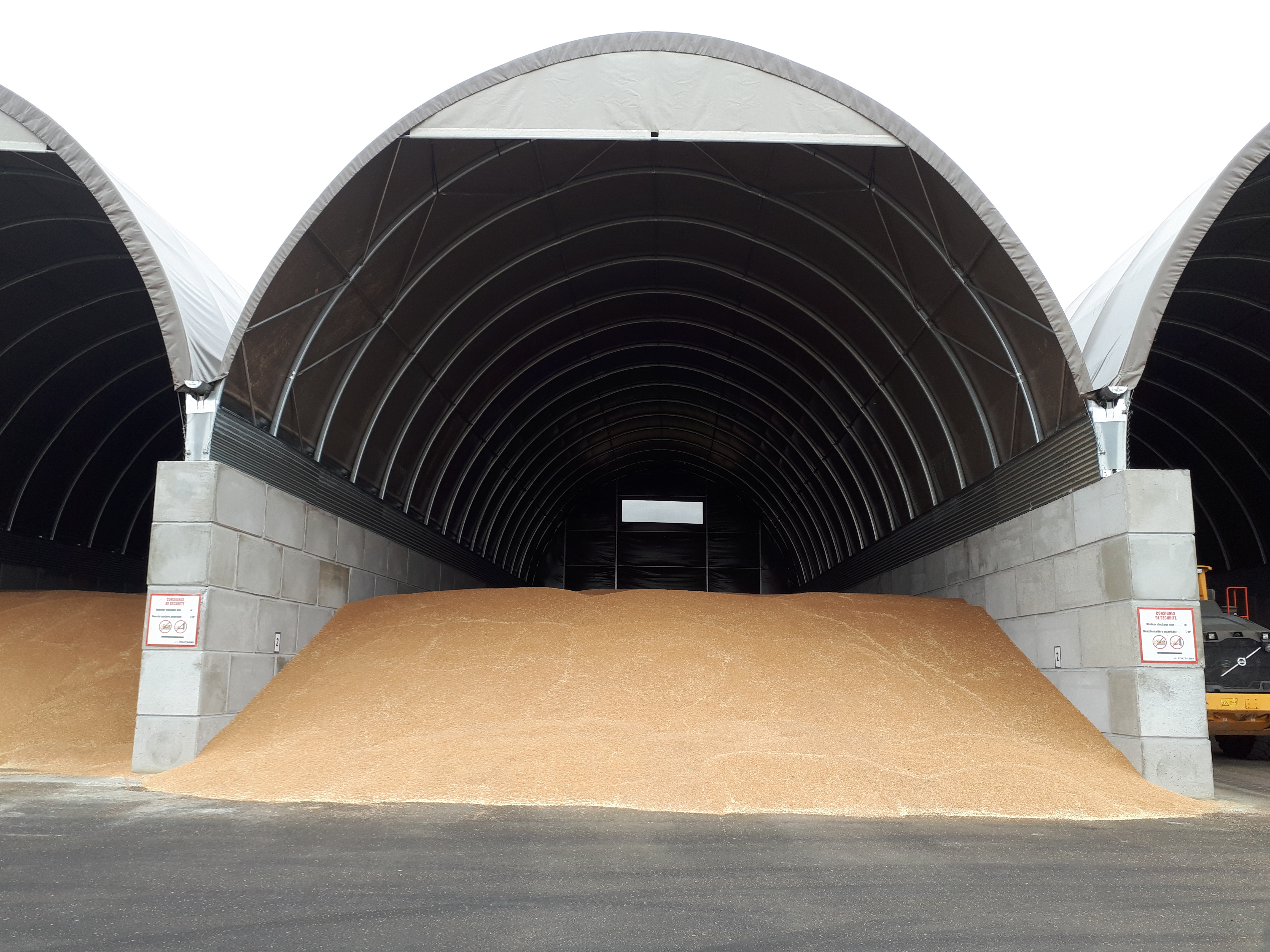
What tunnel storage actually is
A tunnel storage building — sometimes called a polytunnel barn or membrane structure — consists of a galvanised steel arch frame anchored to ground foundations, covered by a UV-stabilised PVC or polyethylene membrane. They are available in spans from roughly 8 metres up to 30 metres or more, in virtually any length, and can be fitted with solid end walls, ventilation panels, and sliding or roller doors.
Modern agricultural tunnel structures are substantially different from the lightweight horticultural polytunnels of the 1980s. Heavy-gauge steel profiles, hot-dip galvanised or powder-coated against corrosion, and multi-layer membranes rated to 25+ years of UV exposure have made these buildings viable for grain storage, machinery housing, hay and straw storage, and even livestock housing in temperate climates.
The cost comparison
This is where the conversation starts for most farmers. A masonry or steel-portal-frame barn — fully engineered, with concrete floor, guttering, and insulated cladding — typically costs between €250 and €500 per square metre to build, depending on specification and region. Planning, foundations, and site preparation add further to the total.
A comparable tunnel structure costs between €40 and €120 per square metre installed, depending on span, membrane specification, and accessories. For a 500 m² storage facility, the difference in capital outlay can be €75,000 to €200,000. Even accounting for a shorter membrane replacement cycle (membranes typically require replacement at 15–25 years versus a brick building's indefinite lifespan), the depreciated cost per year of useful storage space is substantially lower for tunnel structures across a 20-year horizon.
"For a 500 m² facility, the capital difference between a masonry barn and a tunnel structure can exceed €150,000. That is capital that stays in the farming operation."
Assembly time and planning considerations
A masonry or steel-frame barn requires full planning permission, architectural drawings, structural engineering sign-off, and typically six to eighteen months from decision to operational use. A tunnel structure, depending on jurisdiction, may qualify as a permitted development or require only a simplified agricultural notification — and can be erected in days once the foundation anchors are in place.
This speed advantage is not trivial. A farm that suffers storm damage to existing storage in autumn needs a functional replacement before the following harvest. A tunnel structure can realistically be ordered, delivered, and operational within four to eight weeks. A masonry replacement is a multi-year project.
Longevity and maintenance
The honest case for traditional barns is longevity. A well-built brick or block barn has an effective life measured in generations, requires no membrane replacement, and has lower ongoing maintenance costs in a stable environment. For a family farm that has no intention of changing its operation, a masonry barn built today will still be earning its keep in 80 years.
Tunnel structures require periodic membrane inspection, anchor maintenance, and eventual membrane replacement. However, modern membranes have improved dramatically in UV resistance and tear strength. A quality agricultural membrane, correctly installed and maintained, will realistically last 20–30 years before needing replacement — and the replacement cost is a fraction of original build cost.
Which situations favour each option
Tunnel storage tends to win when speed to deployment matters, capital is constrained, storage needs may evolve (tunnel structures can be dismantled and relocated), or when the farm is scaling incrementally and needs flexible additional capacity without large upfront commitment.
Masonry or steel-frame buildings tend to win when the storage use requires high insulation or refrigeration (the thermal mass of masonry is hard to replicate in membrane structures), when the building will house livestock year-round in a cold climate, when planning conditions require permanent structures, or when the farm has a multi-generational investment horizon and access to capital.
In practice, many farms are using both: permanent masonry buildings for primary livestock housing and specialised storage, with tunnel structures providing overflow grain storage, machinery shelter, and flexible additional capacity at a fraction of the cost.
The choice between these two approaches is not about which is better in the abstract — it is about which is better for a specific operation, at a specific point in time, with specific capital available. The most important shift in recent years is that tunnel structures have become a genuine long-term investment rather than a temporary fix, and that has permanently changed how the comparison is made.